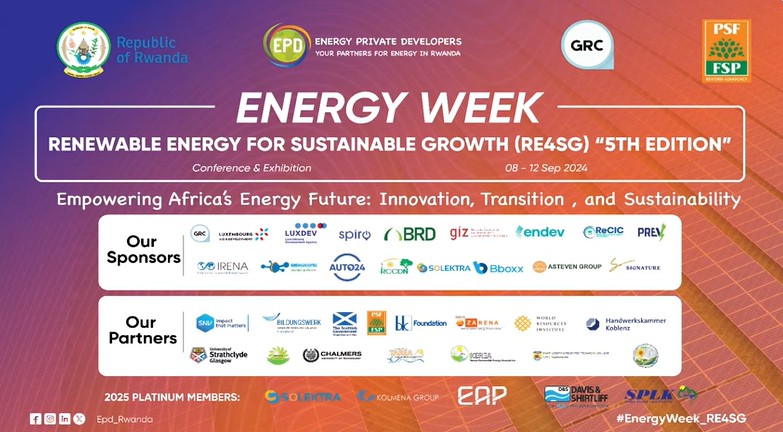
Now in it’s 5th Edition, the Renewable Energy for Sustainable Growth conference has become a key knowledge sharing and collaboration platform for the Rwanda energy sector. Led by GRC partner EPD and supported by GRC colleagues from Scotland, Malawi and Zambia, this year’s event brought together industry leaders, policymakers, investors, and innovators to advance Africa’s sustainable energy future. The three-day conference featured thought-provoking discussions, engaging panels, and enriching field experiences that showcased Rwanda’s leadership in renewable energy development. See for yourself in the highlights and live stream watch again options on EPD’s YouTube channel.
- Day 1 Highlights
- Day 2 Highlights
- Day 1 Live Stream
- Day 2 Live Stream
The conference report is available for view or download.
Summary of Outcomes
The conference centred on “Empowering Africa’s Energy Future: Innovation, Transition, and Sustainability”, positioning Rwanda as a regional model for clean energy deployment driven by private sector leadership, strong policy alignment, and international partnerships. Discussions repeatedly emphasized moving from access numbers to affordability, productive use, and sustainability. Nine main outcome areas are discussed below.
1. Policy, Planning, and National Strategy (NST2 & ESSP)
Key messages
- Rwanda is firmly on track toward universal electricity access by 2030, with over 84% household access and a growing off-grid contribution.
- The private sector is indispensable for meeting the 615 MW generation target and exceeding 60% renewable share by 2030.
- Policy reforms (e.g., raising unlicensed project thresholds from 50 kW to 100 kW) have lowered entry barriers for developers, especially SMEs.
- Remaining challenges:
- High cost of capital
- Affordability for end-users
- Need to diversify beyond hydropower into solar, storage, and hybrid systems
Consensus
Strong political will + coordinated public–private action = Rwanda’s comparative advantage.
2. Financing the Energy Transition
Key messages
- Financing is the primary bottleneck, not technology.
- Successful approaches discussed:
- Blended finance and concessional capital to lower interest rates
- Domestic financial institutions (e.g., BRD, BK) increasingly active in green finance
- Results-based financing models linked to access outcomes
- SMEs face barriers accessing climate finance due to:
- Complex compliance rules
- Limited technical capacity
- Carbon markets and green bonds present major opportunities, but need simplified access frameworks for local firms.
Consensus
Energy transition finance must shift from donor-dependence to bankable, market-based models, especially for rural and off-grid projects.
3. Clean Cooking Transition
Key messages
- Clean cooking is both a health and climate priority, and a major industrial opportunity.
- Rwanda has invested ~USD 20 million annually in subsidies since 2019.
- Emphasis on:
- Tier 3 & 4 stove technologies
- Institutional buyers (schools, hospitals, hospitality sector) to anchor demand
- Local manufacturing and supply chain development
- Critical gaps identified:
- Affordability for low-income households
- Inconsistent adoption due to limited user awareness
- Need for gender-responsive financing
Consensus
Clean cooking success requires integrated policy, finance, gender inclusion, and consumer education—not just technology rollout.
4. Energy–Food Nexus & Productive Use
Key messages
- Energy access is essential to reducing 30% post-harvest losses and increasing agri-productivity.
- Priority applications:
- Solar irrigation
- Cold storage and refrigeration
- Agro-processing
- Smallholder farmers (who produce ~66% of Africa’s food) remain underserved due to:
- High upfront costs
- Weak market linkages
- Cooperative and cluster-based models showed the most promise.
Consensus
Single interventions fail; bundled solutions (energy + water + markets + finance) deliver lasting impact.
5. Gender Inclusivity in Energy Transition
Key messages
- Women are underrepresented in technical and leadership roles despite being primary energy users.
- Effective strategies highlighted:
- Early STEM exposure and role models
- Gender-sensitive finance and lower interest rates
- Mentorship and safe, flexible workplaces
- GRC-supported initiatives show tangible results:
- High female participation in training
- Women-led cooperatives in solar irrigation and mini-grids
Consensus
Gender inclusion is not optional—it is foundational to scaling energy access equitably.
6. Regional Perspectives & Mission 300
Key messages
- Shared African lessons:
- Political leadership accelerates access
- Productive use increases financial viability
- Regulatory clarity unlocks investment
- Countries such as Zambia, Malawi, and Nigeria demonstrated how:
- Policy de-risking
- Grant-backed financing
- Skills development can rapidly scale access.
Consensus
Africa’s energy transition depends on local ownership, cross-border learning, and coordinated reform.
7. Energy Mix: Storage, Mini-grids, Hydropower & Nuclear
Key messages
- Storage is now central to renewable deployment and grid stability.
- Mini-grids paired with smart meters and analytics are cost-effective and investable.
- Small hydropower remains viable but faces:
- High capital costs
- Financing and collateral challenges
- Nuclear energy (via Small Modular Reactors) is positioned as a post-2035, long-term solution for energy security and industrial growth.
Consensus
Short-term focus: solar + storage + mini-grids
Long-term planning: diversified mix including nuclear.
8. Electric Mobility (E-mobility)
Key messages
- Rapid growth in electric motorcycles and emerging EV ecosystems.
- Barriers include grid readiness and charging infrastructure standardization.
- Solutions discussed:
- Decentralized charging
- Second-life batteries
- Public–private investment platforms
Consensus
E-mobility must be planned together with grid and renewable expansion, not as a standalone sector.
9. Role of the Global Renewables Centre (GRC)
Key contributions
- Bridging academia, industry, and policymakers across Rwanda, Malawi, Zambia, and Scotland.
- Tangible impacts:
- Capacity building and internships
- Women-focused initiatives
- Policy-informed research and pilot deployments
- GRC support underpins a significant share of EPD’s coordination capacity.
Consensus
Knowledge exchange is a critical accelerator, not an add-on.
Overall Takeaway
The RE4SG 2025 discussions converged on a single message:
Africa’s energy transition will succeed only if policy, finance, skills, gender inclusion, and productive use are addressed together – at scale, and led by the private sector with strong government partnership.