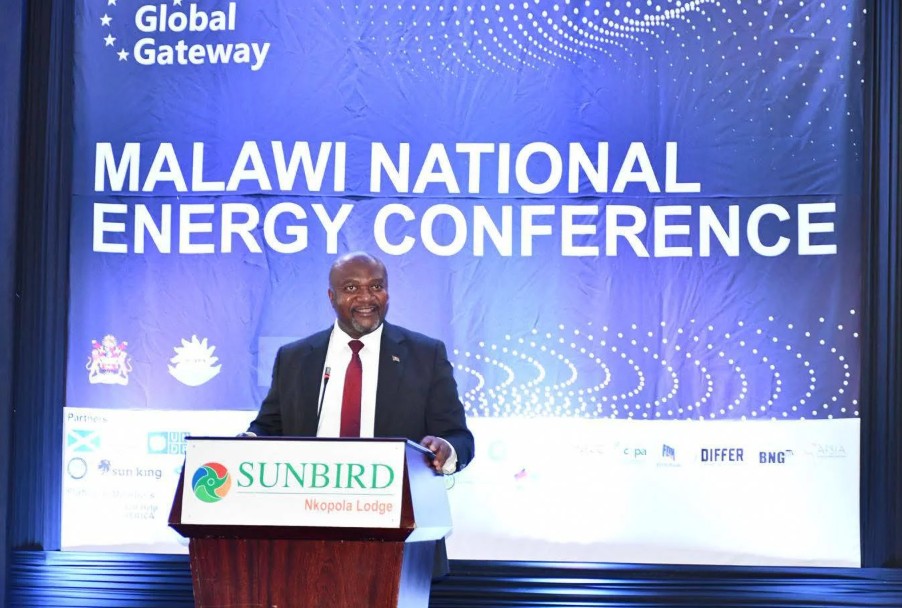
The GRC’s Malawi Partner – REIAMA – delivered another outstanding conference event from 30th July to 1st August 2025, with strong support from the GoM Ministry of Energy and the European Union.
Now in its fourth edition, the Malawi National Energy Conference is now the country’s premier energy sector event, providing a high-level platform for dialogue, knowledge exchange, and partnership building among government, private sector, civil society, donors, and academia.
This year’s theme, “Unlocking Finance for Energy Security,” responded to the urgent need to accelerate investments in Malawi’s energy sector. With only 25% of the population having access to electricity, the event aims to drive innovative financing models and policy reforms to meet the country’s ambitious target of 70% energy access by 2030.
In additional to the GRC’s financial support for REIAMA, the GRC coordinated and delivered a series of expert international contributions for the conference programme (access the presentations here).
Presentations covered:
- Renewable Energy Integration
- 5G Comms for Renewable Energy
- Gender and Social Inclusion
- Opportunities for Partnership and Investment in Rwanda
- Opportunities for Partnership and Investment in Zambia
Conference Overview
OVERARCHING THEME
Unlocking Finance for Energy Security:
Malawi urgently needs coordinated, innovative financing and stakeholder collaboration to bridge the energy access gap—moving from 25.9% electricity access to 70% and 75% clean cooking access by 2030, aligned with MW2063 aspirations.
1. Political Will & Strategic Vision
- The Government of Malawi (GoM) reaffirmed its commitment through the Malawi Energy Compact, targeting both grid and off-grid expansion.
- Vision 2030 by REIAMA includes ambitious goals: no energy poverty, support to healthcare and education, digital transformation, modernized transport (e-mobility), and bankability of energy projects.
- Malawi aims to be part of Africa’s collective goal of electrifying 300 million households by 2030.
2. Financing Landscape & Gaps
- Total financing requirement: US$5.5 billion; only US$530 million secured, leaving a US$4.95 billion gap.
- Emphasis on blended finance, climate finance, carbon markets, and green bonds.
- Catalytic philanthropic capital, result-based financing, and donor leverage (e.g., EU’s €5 billion) seen as critical sources.
- Need for authentic data and bankable projects to unlock capital flows.
3. Role of the Private Sector & SMEs
- The private sector urged to:
- Develop bankable, well-documented projects.
- Engage in blended financing and access to green loan products (e.g., FDH Bank’s offerings).
- Participate in carbon credit schemes and public-private partnerships (PPPs).
- Key challenges: lack of upfront capital, forex instability, weak financial records, and punitive loan terms.
4. Regulatory & Policy Reforms
- Non-cost reflective tariffs hinder ESCOM and deter investors; 52% increase expected in 2025.
- New tariff policies to protect the poor while enabling utility sustainability.
- Institutionalization of the Ngwee Ngwee Fund for clean energy loans and results-based financing.
- Mini-grid policy updated to allow development within 5km of the national grid.
- Reforms in off-grid regulations, waste-to-energy policy, and tax administration underway.
5. Energy Access, Inclusion & Use
- Emphasis on Productive Use of Energy (PUE) to drive agriculture, entrepreneurship, and gender empowerment.
- Master plans developed for electrifying schools and health facilities.
- Promotion of distributed energy systems, cooperatives, and e-mobility as critical pathways.
- Push for consumer protection and crackdown on fake energy products.
6. Grid Integration & Energy Security
- Malawi’s grid reliability is low (59% availability vs. 95% ideal); upgrades needed for integration of renewables.
- Lack of N-1 reliability on key transmission lines (e.g., Central to Northern Region, MOMA) hinders investment confidence.
- Battery storage (20MW) installation at Kanengo underway to improve grid stability.
7. Coordination & Institutional Strengthening
- Call for coordinated energy donor mapping and integrated project pipelines aligned with the Energy Compact.
- Local governments (district councils) must take a leading role in public energy deployments.
- The Ministry of Energy to set up a dedicated resource mobilization secretariat.
- Harmonization across institutions (REIAMA, ESCOM, MERA, development partners) emphasized.
8. Innovation, E-Mobility & Technology
- E-mobility and IoT seen as growth catalysts; however, VAT on EVs and policy gaps (e.g., battery production) are barriers.
- Introduction of Vehicle-to-Load (V2L), V2V, and V2H technologies and smart solar integration.
- OSeMOSYS tool and geospatial platforms promoted for energy planning and evidence-based decision making.
- Green innovation policies are critical to attract foreign investment.
9. Climate Finance & Carbon Markets
- Malawi to leverage SAPP interconnection and register emission factors with UNFCCC to access carbon finance.
- Carbon offset-based loan repayment models proposed (e.g., for clean cooking).
- Need to align energy projects with Nationally Determined Contributions (NDCs).
10. Youth, Gender & Equity Considerations
- Establishment of REIAMA university graduate chapters (e.g., MZUNI) to build youth capacity.
- Focus on inclusive financing, with specific mentions of women’s participation.
- Recognition of energy as a human rights and equity issue—no child or patient should suffer due to lack of power.
Closing Message
The 2025 National Energy Conference reaffirmed that collaboration, financing innovation, and decisive policy reforms are essential to achieve universal energy access in Malawi. All sector players are called upon to turn deliberations into measurable actions, ensuring a resilient, inclusive, and sustainable energy future by 2030.